

Why Marriage Counselling Doesn't Work (And What Does)
I dragged my husband to marriage counselling because I didn’t know what else to do. I thought that was just what couples did, where they went to get help when things weren’t working. Instead of fixing our marriage, we walked out of most sessions feeling even more distant and angry than when we walked in.
That's not just my experience. Research shows the real problem is that counselling doesn’t fit with how most couples (and more commonly most men) actually operate. A 2021 study published in the Journal of Marital and Family Therapy found that couples wait an average of 2.68 years after problems start to book a session and by then the resentment levels are through the roof and one or both partners are over it.
So if marriage counselling doesn't work, what does? I found my answer and turned my own relationship around by practicing the Six Intimacy Skills™, with the help of a Laura Doyle Relationship Coach.
Why Does Marriage Counselling Fail So Many Couples?
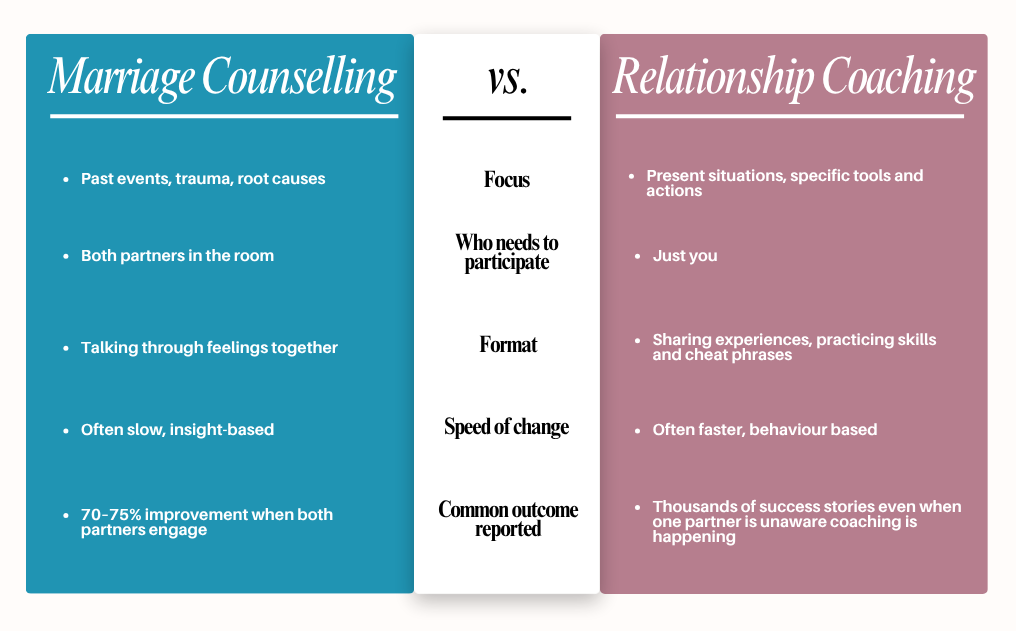
Marriage counselling often fails because it asks two reluctant people to relive old wounds together, out loud in real time. One partner (usually the husband) shuts down emotionally while the sessions rehash blame. Instead of building new habits, the couple leaves each week feeling worse, not better.
Now, it’s not all bad news. Research from the Journal of Marital and Family Therapy puts general improvement rates for couples therapy at 70 to 75 percent for emotionally focused therapy. The catch is that those numbers assume both partners show up willing to change and stay engaged for the full course of sessions. Butthat's rarely how it plays out.

A 2003 review in American Psychologist found men are consistently more likely than women to delay or avoid therapy altogether (Addis & Mahalik, 2003).
If your husband is anything like mine then he only agreed to couples therapy because I begged him. I was desperate to keep our family together and avoid awkward parenting handovers or missing every second Christmas with our kids. But no amount of trying to get him to talk about his feelings was going to make him fall back in love with me or take responsibility for the lawn that I’d already complained about and asked him to mow four times in the last week. When he agreed to go with me I held onto the tiniest sliver of hope that the counsellor would get through to him and make him see how cold and distant he was acting. But every session left me more convinced that my husband didn’t care.
Here’s the truth:
1. Most Men Would Rather Do Almost Anything Than Talk About Feelings
Counselling assumes both partners want to sit in a room and process their emotions verbally and for a lot of men, that's the opposite of how they're wired to connect. Asking an emotionally distant husband to communicate how he’s feeling while his wife and a practical stranger sit there staring at him is not exactly conducive to getting him to open up.
This isn't a character flaw in him. It’s just not how men are wired and no amount of reassurance is going to convince him he’s in a safe enough space to step into that perceived ambush.
2. Rehashing What's Wrong Makes You Feel Worse, Not Better
Spending an hour pointing out everything that's broken in your marriage (and who's to blame for it) trains your brain to notice more of what's not working. Psychologists call this attentional bias: what you focus on expands.
While it might feel good to get it all out in the open, without the tools to refocus your thinking, you’ll leave the session even more aware of everything your partner does to piss you off and a mounting list of evidence to support your resentment.
3. Looking Backward When You Need a Forward Plan
Traditional counselling spends most of its time on the past (childhood wounds, old arguments, the origin story of the resentment) with far less time on specific, repeatable actions to take this week. Understanding where a pattern came from doesn't automatically tell you what to do differently when he leaves his dirty clothes on the bathroom floor beside the laundry basket again tonight despite you asking/telling/pleading with him not to.
That gap between insight and action is where a lot of couples get stuck. Knowing why he withdraws doesn't teach you what to say or do the next time he does it.
What Is Relationship Coaching and How Is It Different?
Relationship coaching is action-based support that trains you in specific skills that you can practice to improve your relationship without his help.
As a certified Laura Doyle Relationship Coach I have personally used the Six Intimacy Skills to transform my own marriage from distant and broken to playful and peaceful and I want that for you too.
The Six Intimacy Skills are the framework Laura Doyle built after interviewing long-married couples about what actually kept them close. More than 150,000 women have gone through her programs to date, according to DatingAdvice.com.
Unlike counselling, coaching only requires one willing participant: YOU. Your coach isn't a neutral referee between two people, she's in your corner, giving you specific support based on your own situation, standing for you and for your marriage and troubleshooting with you between sessions.
Why Coaching Only Needs One Person to Change the Marriage
When a wife starts practicing the Six Intimacy Skills and showing up differently in the relationship, her husband typically responds to her in a new way.
That tired old pattern (bickering, nagging, criticising, controlling) no longer has anything to push against. This is the core mechanic behind why relationship coaching can work even in a one-sided marriage. You're not persuading him to change, you're choosing to be the best version of yourself and removing the behaviours that were (unwittingly) keeping him distant.
My Own Experience: From Hopeless to Him Showing Up as My Hero
While marriage counselling left me feeling helpless and angry with no clear plan of how to move forward, learning the Six Intimacy Skills with the support of a certified coach gave me step-by-step actions to take that didn’t rely on anyone but me. Slowly, my husband started coming closer instead of pulling away. He lingered to chat after the kids had gone to bed. He bought me little treats when he stopped to fuel up his car and he even baked me a special birthday cake. I started looking for (and finding) all the ways he was a great husband who just wanted to make me happy.
This blog post walks you through exactly how that shift started.
Without finding these skills, I'm confident we'd be divorced. That's not a claim I make lightly, and it's why I now coach other women through the same process. If you're wondering whether you're the only one carrying the relationship, read about the loneliness I felt prior to coaching before you assume counselling is your only option.
FAQs: Marriage Counselling vs. Relationship Coaching
Q: Why doesn't marriage counselling work for most couples?
A: It often fails because it requires two willing participants, focuses on past hurt over present action, and can leave couples more focused on grievances. Success also depends heavily on timing and mutual engagement, not just the therapist's skill.
Q: Can I save my marriage if my husband won't go to counselling?
A: Yes. Relationship coaching is designed for one partner to practice alone. Many wives report their husbands responding to the new dynamic without ever knowing coaching was involved.
Q: What are the Six Intimacy Skills?
A: 1. Replenish your spirit with self-care 2. Respect 3. Relinquish inappropriate control 4. Receive 5. Reveal your heart with vulnerability 6. Refocus your view with gratitude.
Q: Is relationship coaching a replacement for therapy?
A: Coaching focuses on relationship-specific action steps and communication tools, not clinical treatment for trauma or mental health conditions. Some women use both. A skilled relationship coach will be able to help you decide if coaching is the right fit for you and your relationship.
Q: How long does it take to see a difference with relationship coaching?
A: It varies by couple, but many women report their husband responding to small shifts in behaviour within weeks (sometimes days) of consistent practice, since the change in dynamic starts as soon as the old pattern stops.
The Bottom Line
Marriage counselling isn't useless, but it asks for something a lot of marriages don't have: two people equally ready to talk it out. Relationship coaching sidesteps that entirely by giving you skills you can start using today, alone, without waiting for him to agree.
If your marriage feels hopeless right now, it doesn't mean it is. And you’re not alone. Book a free relationship strategy call and let's work out your best next step together.
