

Can You Change Your Marriage Without Your Husband Trying?
Yes, you really can change your marriage without your husband trying. As one half of a couple you have a lot more power than you think! By simply showing up differently, changing the way you act or react and discovering a new perspective, you can change the whole dance and have your husband wondering who you are and what you did with his wife (in a good way). Research on individual therapy backs this up and it's the exact approach I used to bring the connection back in my own marriage.
If you've ever cried in the shower so the kids wouldn't hear, or laid awake next to a man who feels more like a stranger than a husband… I want you to know, you are not stuck and you are definitely not alone.
You've probably been told the only way to fix a marriage is for both people to "do the work." Get him to read the marriage books. Learn to communicate better with each other. Go to marriage counselling and sit across from a therapist together every week until one of you either gives up or gives in.
But here's what nobody tells you: your marriage doesn't need two willing participants to change. It only takes one person willing to show up differently. And that person is you. A marriage is like a dance and when you change the steps, your partner might be thrown off balance for a while but he’ll soon come to recognise the new music that's playing and the whole dynamic shifts, whether or not he's consciously trying.
I know that sounds too good to be true. I thought so too, back when my own marriage felt like it was circling the drain. But I can tell you from my own lived experience (and that of my clients) that this isn’t just a nice idea, it works. And I can show you how you can do it too.
Who Says You Can't Change Your Marriage Alone?
Most relationship advice assumes both partners need to attend therapy for anything to shift.

This assumption isn't entirely wrong, but it's incomplete.
Conjoint therapy where both partners attend together is often considered the gold standard for treating relationship issues. That's the model most of us are familiar with: book the counsellor, nag/beg/convince him to come along and hope he opens up. It's what I did. It's probably what you've tried or thought about trying too.
The problem is that this model only works if both parties are willing participants. If your husband doesn’t want to go or doesn’t feel the need to change, when he can’t or won’t open up and share his deep dark feelings with a stranger, then the whole approach collapses and you're left feeling more hopeless than before you started.
What Does the Research Actually Say About Changing a Marriage Solo?
Here's where it gets interesting. Individual therapy (where only one partner attends) has been shown to measurably improve relationship satisfaction according to clinical psychologist Dr Jacqueline Baulch.
Simply put, when one partner puts in the work, it changes how they interact with their spouse and that shift changes the relationship, even without the other person making any conscious changes of their own.
So what is “the work” I hear you ask? Well in my case it was learning and practicing the Six Intimacy Skills™ as described by Laura Doyle, best selling author of The Empowered Wife.
When my marriage was falling apart I was desperate to fix it. My husband had moved out, I was raising our three young kids and while he wanted to be part of their lives, he didn’t want to be around me. I was heartbroken (and angry if I’m honest) and terrified of what the future would hold. Marriage counselling only seemed to make things worse for us and I was clutching at straws, searching for a miracle to keep our family together when I found Laura’s book.
Why Don't Most Marriage Problems Actually Get "Solved"?
Even in the happiest of marriages, there’s often a few arguments that seem to keep coming up over and over again. In my case the big things we disagreed about were money, parenting and well-meaning interfering in-laws.
Decades of research by the Gottman Institute found that 69% of relationship conflict is "perpetual", meaning it stems from basic personality or lifestyle differences that never fully go away.
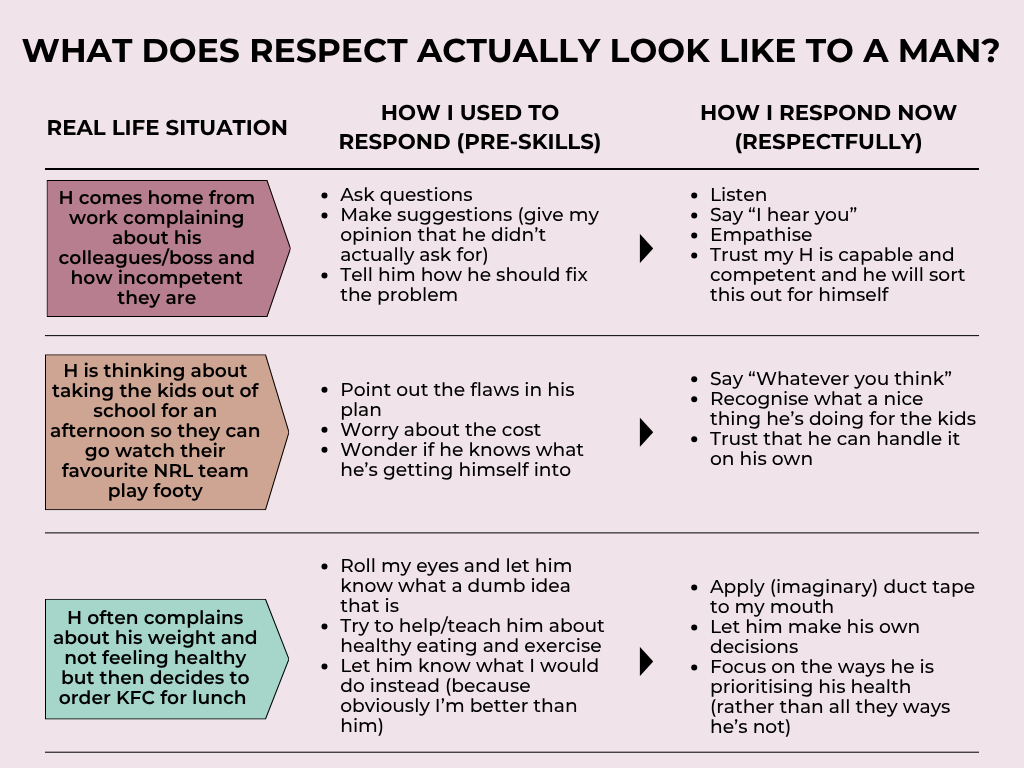
When I look back now, I can see that a lot of our repetitive arguments were due to a lack of respect. At the time, I’d thought that I was a respectful wife, but what I didn’t realise is that men and women can have very different ideas of what it means to be respectful. And for men, respect is like oxygen.
Whenever I rolled my eyes at my husband for agreeing to work overtime (again) or corrected him when he parented our kids in his own way rather than my way, when I told him how to drive or accepted an invitation to attend a family gathering on his behalf, I thought I was being helpful when actually I was being disrespectful.
When I questioned his decisions or told him how he should handle things at work, when I didn’t trust him or believe the best in him, I was slowly chipping away at his independence and sense of masculinity. I was trying to change (improve) my husband in so many ways, and not only was it not working but it was also creating distance between us.
What Changes When You Focus on Respect?
This is the part that surprises almost every woman I coach. When you stop trying to manage, fix or help your husband and instead start really hearing him and trusting that he is a smart and capable man, he becomes less defensive and feels safe to start sharing more with you.
Restoring respect by being accountable and apologising for the ways in which I had been disrespectful was a huge deal for our relationship. It was a relief for my husband but also for me, because choosing to trust that he can take care of himself and be the strong, hardworking, generous man I fell in love with was a powerful shift for us both, one that eliminated a lot of the perpetual conflicts that we’d been engaging in.
When I stopped criticising, insulting, contradicting and belittling him and focussed on trusting him and expecting the best from him, my husband stopped having to defend himself or his ideas and he was able to show up as my hero. It also meant that I didn’t have to take on the burden of fixing his problems, I could just listen and support him to sort it out on his own, which was such a relief! We reconnected in a way we hadn’t for a long time and I started to see glimpses of the man I first fell in love with, the man who would do anything to make me happy.
Think about the woman you were when he first fell in love with you. She probably wasn't anxious, controlling or thinking she was better than him. She probably thought he was responsible and kind and she liked they way he took care of her.
When you add in the rest of the Intimacy Skills something else shifts too. You become please-able. And your husband starts mirroring you, offering more, not because you asked but because it finally feels safe and rewarding to give.
Even if your husband is currently talking about divorce (read this post next), this powerful shift, showing that you respect your husband in the way that he sees respect is often the thing that stops him in his tracks and makes him think about whether he’s making the right choice.
FAQs: Changing Your Marriage Without Your Husband’s Help
Q: Can my marriage really improve if my husband refuses counselling?
A: Yes. Individual work, where you change your own behaviour has been shown to shift relationship dynamics even without your husband's conscious participation because a relationship is a system that responds to change from either side. Sound unfair? Read this next: “Why Am I The Only One Working on Our Marriage?”
Q: What if my husband doesn't even notice I'm trying to change?
A: He usually does notice, even if he doesn't say so at first. Most women find that becoming happier, calmer and less controlling (more respectful) is felt by their husband within weeks (sometimes with just a single interaction where he feels heard and respected), long before any conversation about it happens.
Q: Is this the same as just "giving up" on the marriage?
A: No, it's the opposite. Instead of giving up, you're redirecting your energy toward the one thing guaranteed to influence the relationship: yourself (and choosing to show up respectfully), rather than a partner who can't be forced to change.
Q: How long does it typically take to see a difference?
A: Many women notice small shifts in their husband's mood and engagement within a few weeks of consistently practising the Six Intimacy Skills, though every marriage and timeline is different. If you’re not seeing changes yet, support is available. [link to Strategy Call]
Q: What's the very first step if I want to try this approach?
A: Start with really listening to your husband and simply saying only “I hear you”. It doesn’t mean you agree or disagree with him, just that you’re bearing witness. Notice his response. Does he seem less defensive? Does he keep talking? How do you feel when you don’t have to give your opinion or try to fix his problems?
Q: What if my husband is saying he wants a divorce? Do I still respect his decision even if I don’t agree?
A: Yes. As hard and painful as it is, responding with “I hear you” can be powerful. When he feels heard and doesn’t have to defend or convince or argue with you, this can be the start of a new dynamic between the two of you, one where the emotional safety and intimacy is starting to be rebuilt from the ground up. (For your next step I suggest reading this post.)
You Don't Need Him to Try in Order to Start
Your marriage doesn't need a willing husband, a counsellor's couch, or a perfect apology to begin changing. It needs you, practising one skill at a time, starting today.
I know how impossible that can feel from where you're sitting right now. I've been there. But you have more power over the direction of your marriage than you've been led to believe. Ready to get started? Download my free guide: "Happy Marriage Action Plan” and find out exactly where to begin, even if you're the only one trying right now.
