Feel like you've tried everything to save your marriage? I thought the same. Here are the skills I learned that finally made a difference, and how they might work for you as well.
Last updated: 19 November 2026
Approximately 49,000 divorces were granted in Australia In 2025 according to the Australian Bureau of Statistics. A few years ago my own marriage came close to boosting that number. If you’d asked me then, I would have told you I’d tried everything to save my marriage.
We’d been to marriage counselling (which only seemed to make things worse) and I’d read every book I thought might help, most of which were good in theory but had zero practical applications. I’d picked fights just to try to get him talking, thinking that communication would help (it didn’t). I begged, pleaded, told him what I needed from him and had a mental list of everything he could/should do differently, and none of it made a difference.
Saying "I've tried everything" usually means you've tried everything to get your husband to change (at least it did in my case). When I discovered The Six Intimacy Skills, I realised there was a whole lot I could do to change my relationship by focussing on myself and how I was showing up, rather than what my husband was doing (or not doing). If you’re not familiar with them, the Six Intimacy Skills are a set of proven practices from best selling author Laura Doyle’s book, The Empowered Wife.
Below is an outline of each skill and what they did for my marriage. Plus some practical action steps that you can take to start making a difference in your own relationship.

Why does "I've tried everything to save my marriage" feel so true?
It feels true because repeated effort without results teaches your brain to stop expecting results. Psychologists call this learned helplessness, a state where a person stops trying because past attempts changed nothing.
A 1976 review by Maier and Seligman in the Journal of Experimental Psychology described dogs who had been given shocks they couldn’t control, later failing to escape shocks they could have avoided.
Firstly, what a horrible experiment and secondly, I'm not comparing you to a dog (or your husband to an electric shock) but the pattern is familiar. When every attempt to reach your husband ends in a fight or him shutting down, giving up starts to feel sensible.
The important word in "learned helplessness" is learned. Anything learned can be un-learned or learned differently.
What if there’s no hope? How do you get it back?
Reading The Empowered Wife for the first time was like a mic drop moment. Hours earlier I had cried myself to sleep, angry at my husband and at the same time so incredibly lonely and desperate to bring back the love and trust we’d shared in the beginning. When I woke in the middle of the night and typed into google “My husband doesn’t love me anymore” I was not expecting to find anything particularly helpful but the promise of being able to fix my marriage on my own, the realisation that there were actual “skills” I could learn to be better at relationships was too powerful to resist. I downloaded it onto my kindle so I could start reading straight away and for the first time I started to feel hopeful that there was something I could do that didn’t rely on my husband changing or even knowing what I was working on.
Hope, according to psychologist C.R. Snyder, is a motivational state with three parts, and you can build it. The first part is your goal. The second is the pathways you could take to reach that goal and the third is agency, meaning that you believe you have the motivation to take those pathways and work towards your goal. When one part fails, hope slips. Most of us lose hope in a marriage because every pathway we can see runs through our husbands. It relies on him changing or treating us differently or working just as hard as we are to fix the relationship. If he won't, then every route is blocked and we lose our agency.
The Six Intimacy Skills give you pathways that don't need his permission or cooperation. You may have run out of options that depend on him, but that doesn’t mean you’re out of options.
Here’s what I tried. And then what I did differently once I found the Skills.
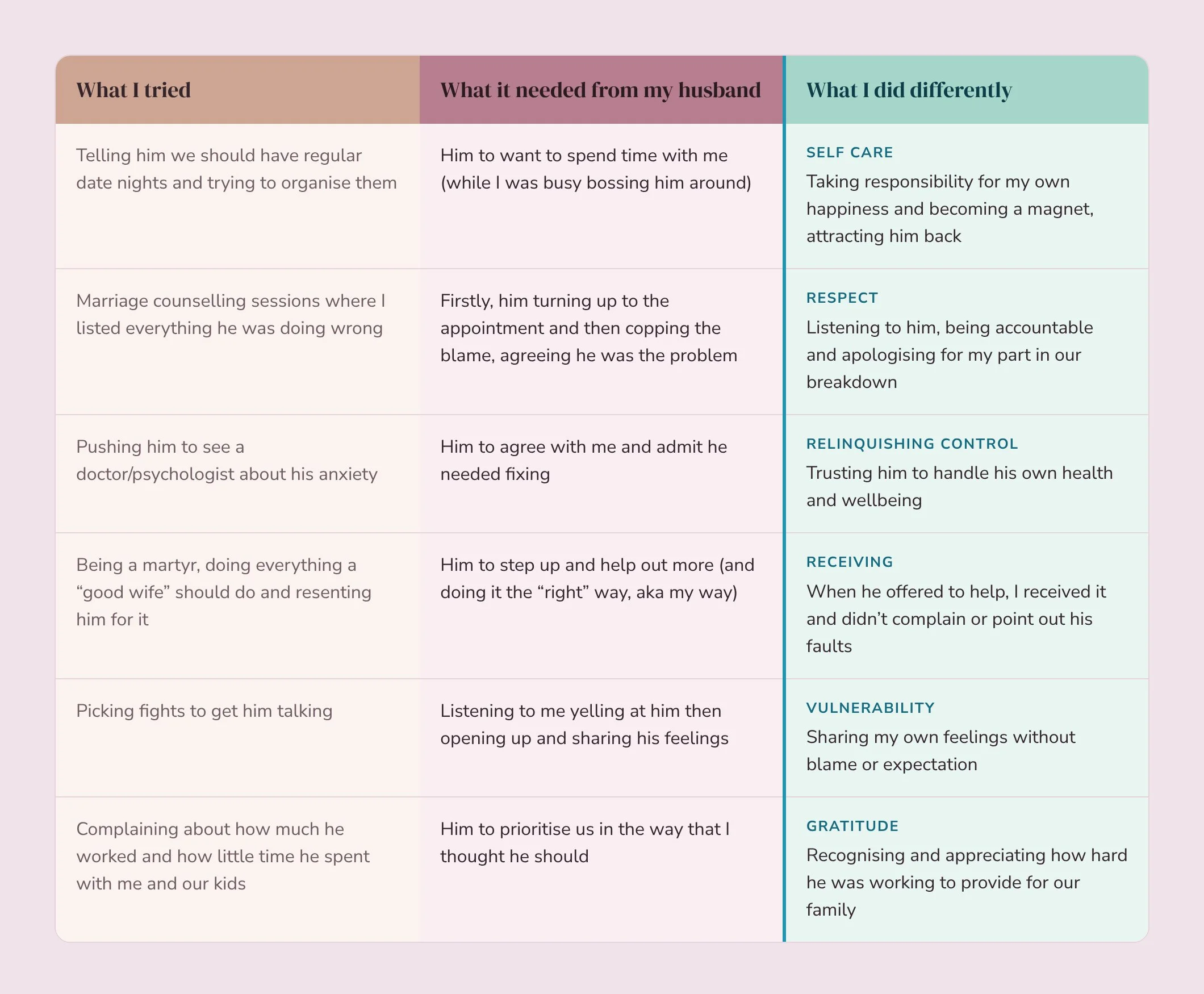
Every strategy I tried before the Six Intimacy Skills needed my husband to do something different, which meant I was bashing my head against a brick wall trying to convince him to change. This table gives a few examples of things I tried, what it needed from him, and the skill that replaced it - the skill that was completely within my power to practice, with or without his help.
What are the Six Intimacy Skills?
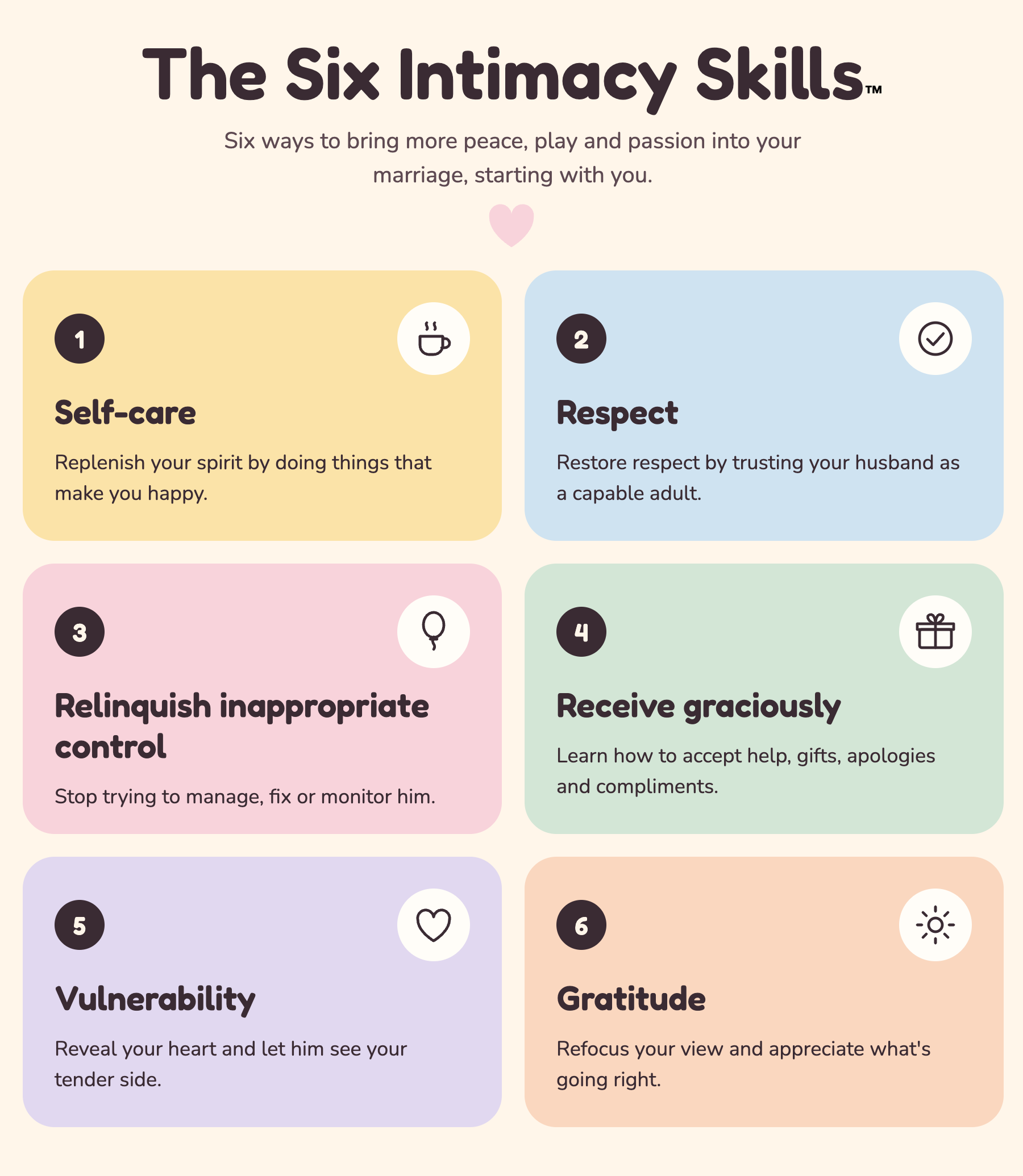
The Six Intimacy Skills are just that. Six skills created by Laura Doyle (best-selling author of The Empowered Wife) that a woman can practice to transform her marriage and make her relationship more intimate (often without his knowledge).
As a Certified Laura Doyle Relationship Coach I now help women use these skills in their own marriages but my first experience with them was as a desperate wife in the middle of my own marriage breakdown.
Skill 1: How does self-care change a marriage?
Self-care, the first and indispensable skill, is about choosing to make time for things that make you happy and recognising that your mood is within your control. You will have heard the saying “Only happy people have happy marriages”. If you can’t make yourself happy first then what chance does your husband have of making you happy? Self care changes a marriage because you stop expecting him to fill a tank you’ve left empty.
I used to think self-care meant bubble baths and salon appointments or girls weekends away. Those things are great, but not something most women can commit to doing daily. When things were at their worst I started small, just five minutes, three times a day of doing something that would get me out of my head (where I was hurt and angry and miserable) and make me smile, even just a tiny bit. Coffee with a friend, reading a good book, watching funny reels, an ongoing creative project, or taking the kids to the park gave my mind a break from the neverending worry and misery. It also gave me something to talk about besides my marriage and how sad I was.
The result? My husband noticed me smiling more. He started staying a bit longer when he came to see the kids, and we laughed together again. Bit by bit, I became happier and my good mood was attractive. Waaaay more attractive than the miserable, desperate, needy wife I was beforehand.
Skill 2: What does respect mean in a marriage?
Respect, the second skill, means honouring your husband’s choices, not necessarily agreeing or disagreeing but trusting that he’s a grown man and knows how to live his own life without you helping, correcting, advising or speaking for him. Doyle gives respect its own segment in an interview on Utah State University’s “Stronger Marriage podcast", where she explains why it matters so much to husbands.
In my failed attempt to fix our marriage through counseling I thought I was being helpful when I answered questions on my husband’s behalf or added in some details he’d left out. What I didn’t understand at the time was that I was really saying I didn't trust him to speak for himself. The subtext was “I’m better than him”. No wonder he despised those sessions.
When I started just listening to him, really hearing him and not trying to offer help with problems he could solve on his own, I saw him step up and shoulder more responsibility. He went back to being the competent, hard-working man I’d married. I was no longer acting like his mother, which (aside from putting me back in the lover category) also left me a lot more time to focus on my own happiness.
Skill 3: Why does letting go of control help?
Relinquishing inappropriate control, the third skill, means giving up trying to manage, fix or change your husband. Control is just an illusion because the only person you can truly change is yourself. Control might feel like effort, meaning it’s easy to mistake for love but really it’s rooted in fear.
I thought my attempts to save our marriage showed how hard I was trying and how much I cared. I was so afraid of what would happen if I stopped trying to hold it all together and we divorced. The thought of sharing custody of our kids, spending holidays apart, what it would mean for our finances, the heartbreak of having to watch him move on because I was so sure nobody would want a heartbroken single Mum with all the emotional baggage I was carrying around… I was terrified. But when I learned about the skill of relinquishing control, I cancelled the counselling appointments, stopped pushing my husband to see a doctor or psychologist about his anxiety, gave up walking on eggshells and trying to make him happy and I turned my focus to what I could control - myself.
As my marriage mentor Laura Doyle says, "Helpful in wife language is controlling in husband language." I hadn't been failing from lack of effort. I had been failing because I was trying too hard.
Skill 4: My husband doesn’t buy me presents so how can I practice receiving?
Receiving graciously, the fourth skill, is not just about receiving gifts but also accepting help, taking in compliments without deflecting and letting apologies land without downplaying them. Receiving means saying a simple “thank you”. It works because he can finally succeed at doing something nice for you.
I thought I was great at receiving but when someone complimented my appearance or achievements I was so quick to dismiss the comment by pointing out what was wrong with my outfit or that I was having a bad hair day or to compliment them back, trying to shift the focus to them. It felt uncomfortable to take it in and believe their kind words.
If my husband offered to put the baby to bed I would tell him not to worry about it because I knew it would take less time if I did it myself, even though I was exhausted and wanted nothing more than to sit on the couch, without any little hands touching me, and close my eyes for a bit.
When he bought me a gift I would thank him but I’d also be annoyed because my birthday was three weeks ago and why couldn’t he organise to have the gift ready on time?
My husband just couldn’t seem to get anything right, so he stopped trying. When I learned to receive graciously, it took a little while but eventually it became safe for him to help again, to try and lighten my load and show me he cared.
Laura Doyle defines receptivity as “the essence of femininity”. And she’s right. I’ve seen the way a man will square his shoulders and stand a little taller when I accept his offer to lift a heavy bag of dog biscuits into the boot of my car (even though I’m perfectly capable of lifting it myself). He gets to feel chivalrous and I get to feel taken care of. Receiving has to be one of the funnest skills to practice and it’s amazing how much a simple “thank you” can make my husband seem like my hero and protector.
Skill 5: Isn’t vulnerability a weakness?
Vulnerability, the fifth skill, takes courage. Opening yourself up and sharing tender emotions or admitting your limits is not for the faint of heart. It’s also essential for creating the deep connection and intimacy that we yearn for in a relationship.
The first time I said “I can’t’, the words felt completely foreign to me. I’m a strong, independent woman so telling my husband I was too exhausted to get the kids home after a long day out and cook dinner and do the bedtime routine by myself felt like giving up when I should have been pushing through. But the way he softened when he looked at me and then told me he’d come over and help made me think differently about the power of vulnerability.
I had found myself in tears in front of my husband plenty of times before that moment but they were usually angry tears or I was crying out of desperation, trying to manipulate or convince him not to leave me. When I was able to let go of the blame and control and just surrender to my feelings without any expectations, I felt raw but also free. And whenever I’ve had the courage to be vulnerable, whether it’s with my husband or a coach or girlfriend, I'm always surprised at how much closer it brings us.
Skill 6: Why should I be grateful when he’s just doing what he’s supposed to be doing?
Gratitude, the sixth skill, starts with noticing what your husband is already doing to make your life that little bit easier (like taking the kids to sports or picking up dinner on his way home) and thanking him for it. Are these tasks quite small in the scheme of things? Yes. Isn’t it his job to be a Dad and help out around the house? Also yes. Hear me out.
When my marriage was on the brink of divorce, all I could see was what was going wrong. All the things my husband didn’t do, wouldn’t say or couldn’t understand. When my coach invited me to try gratitude, my mind went blank. What could I possibly thank him for when I felt like I was doing everything and he wasn’t even trying?
When I started to look for things to be grateful for though, I found them. I’d complained in the past (a lot) about how my husband worked too much and that became a reason to thank him for supporting our family. I would roll my eyes when he went grocery shopping without taking the list because he’d come home with things we didn’t need and forget the essentials. But he went grocery shopping so I didn’t have to.
Thanking my husband not only made him feel appreciated and more likely to want to do even more for me, but it also changed my perspective and helped me to see all the ways he was trying to be a good husband and father. It was tempting to see all the ways he was falling short of my expectations, but I found that what I focus on increases. The more I look for things to be grateful for, the more I find. Gratitude is a powerful antidote to resentment and given the choice (because it is definitely my choice), I’d rather feel grateful any day of the week.
What can you expect when you practise all six skills?
The change in my marriage was gradual and I can't promise you a set timeline. It had taken eight years of marriage to get to our lowest point, when my husband told me he didn’t love me and was moving out. I realised soon after I discovered the intimacy skills that I couldn’t repair eight years of unwitting disrespect overnight (as much as I hoped and wished I could).
What I can tell you is that little by little, as I worked on myself, practicing all of the skills with the help of a supportive coach, the wins started piling up. I found my smile again through self care, I stopped trying to change him and chose how I wanted to show up in each interaction. I was accountable for the part that I played in our breakdown and I chose faith over fear that everything would work out for the best. Our interactions became cordial, then friendly, and then the playfulness and passion came back.
I went from hopelessness and despair, thinking I had “tried everything” to convince my husband not to leave me, to finding the skills and becoming the best version of myself, which allowed me to attract him back. I still have bad days, I’m only human. The difference is that I now know which skill to reach for when one arrives.
FAQs: I've tried everything to save my marriage
Q: Can I save my marriage if my husband won't change?
A: In my experience, yes, because the Six Intimacy Skills only ask you to change your own behaviour. When I stopped controlling, criticising and fixing, my husband stopped defending himself and started stepping up. The timeline is different for everyone but as a woman, you set the tone in your relationship and you have a much greater influence than you might think.
Q: What are the Six Intimacy Skills?
A: They are self-care, respect, relinquishing inappropriate control, receiving graciously, vulnerability and gratitude, as taught by relationship expert Laura Doyle in her book The Empowered Wife. Each skill has practical actions that you can take to change your own behaviour, which has a flow on effect in your relationship.
Q: What if marriage counselling didn't work for us?
A: Counselling doesn't suit every couple, and it didn't work for me. It became an hour of complaining and reliving the past each week, and only seemed to make my husband angrier and more closed off. The skills gave me something different to do: practise daily habits on my own side of the marriage. When I changed the steps to our old dance, my husband did too, even if he had no idea what the song was. Or that we were even dancing.
Q: How long do the Six Intimacy Skills take to work?
A: It varies. I noticed small shifts early on (like my husband staying longer to talk to me when he came over to see the kids) while bigger changes took more time. Consistency matters more than perfection and having a coach to guide you helps speed up the process for sure.
Q: What if my husband is having an affair?
A: That’s heartbreaking and I’m so sorry you’re going through that. In my experience, these skills still work even when he’s seeing someone else (you’ll find plenty of real-life success stories on the Empowered Wife Podcast). He chose you first. It may not feel like it right now but if you still love him and can’t imagine life with anyone else, if you want to attract him back, then there is hope. I invite you to reach out for support and book a call with me - you don’t have to be alone in this.
Start with the first skill
I thought I’d tried everything to fix my marriage, but it wasn't until I tried the Six Intimacy Skills that I found something that actually works. If you’re looking for a proven way to have a relationship where your husband calls you in the middle of the day just to check in or he cooks you special dinners and books beach holidays just because you express a desire then you’ve found it.
I’m not saying it’ll be easy, and it probably won’t happen overnight, but this is something you can do that doesn’t depend on him making the first move. Self-care is the first of the six skills for a reason and even just spending five minutes doing something that you enjoy (not something you think you should be doing but something that brings you joy in the moment) can start to make a difference. That difference starts with your mood and you’ll be surprised how a shift in your mood can have a ripple effect on other parts of your life.
If you need ideas, grab my free download: 50 Self Care Ideas for Busy Women